From Screaming Eagle to Sine Qua Non, The History of Cult Wines in the U.S. | Wine Enthusiast


Have you ever wondered what cult wines are and how they came to be? Discover their auspicious origin stories here.
Twice a year, California winery Sine Qua Non sends out a note to its substantial waitlist.
“If there is ever a task that I, good old Manfred, don’t like to perform, it is writing and sending this note,” wrote co-owner Manfred Krankl in a 2019 missive. “Communicating about wines we sadly don’t have enough to offer to everyone interested is clearly a miserable task… Thank you so much for your patience and kindness. It is greatly appreciated. We are so happy you are there and can’t wait to get some juice to you.”
Sine Qua Non isn’t the only winery for which demand outpaces supply. Wait lists are the norm for cult wines.
But what is a “cult wine,” exactly?
While some winemakers dislike the term, it has come to encapsulate three main things: scarcity, high prices and quality. Many consider Napa Valley the birthplace of the cult wine phenomenon, and so its most famous grape, Cabernet Sauvignon, comprises many of the world’s most sought-after cult wines. However, there are cult wines made from other grapes and in other regions around the world.
As U.S. wine drinkers developed their palates in the latter half of the 20th century, reviewers played a large part in establishing the reputation of many of the country’s enduring cult wines. Now, cult bottlings are generally only available to purchase if you’re on the allocation list or via the secondary market.
Napa’s Cult-Like Following
In 2008, a billionaire purchased six magnums of Screaming Eagle’s 1992 Cabernet Sauvignon for $500,000. Only 225 cases of the wine were ever made and it’s among the most coveted brands worldwide.
But Screaming Eagle’s team never set out to make a cult wine.
According to Heidi Barrett, Screaming Eagle’s original winemaker, the brand didn’t really exist in its current form when she began working there. She’d been making wine down the hill at Dalla Valle and the owners gave her a directive: “Go help Jean [Phillips, the founder of Screaming Eagle] make wine,” she says. “It was a no-frills, pay-by-the-hour situation.”
In 1992, Barrett made 175 cases of Screaming Eagle. Phillips sold that Cabernet blend at Napa’s famed Oakville Grocery, and it was on the list at Bistro Don Giovanni.
But they also gave a lot of it away.
When the owners of Screaming Eagle began entering the wine in local competitions, however, the kudos began to roll in.
As whispers of how good Screaming Eagle was grew in volume, Phillips priced the wine at $75, an unprecedented move at a time when high-end domestic wines often maxed out at about $50. That led a friend, unbeknownst to Phillips and Barrett, to give the wine to Robert Parker to review. He initially gave it 99 points. However, after sitting with it for a while, he rescinded the score and re-scored it at 100 points.
Some wondered if this sudden success was a fluke. But Screaming Eagle became globally renowned, and its success catapulted Heidi Barrett into the spotlight as one of the most respected consulting winemakers in the world.
Around the same time, another winery producing a sought-after Cabernet blend, Harlan Estate, was emerging in Napa. Unlike Phillips, Harlan Estate founder Bill Harlan deliberately set out to create a notable wine, one that he calls a “California First Growth” of grand cru quality.
“Rhône wines always felt non-arrogant.” —Manfred Krankl, founder, Sine Qua Non
According to Brett Anderson, director of culture and communication at Harlan Family Wines, Harlan had a rather fortuitous call with Robert Mondavi in 1979 that persuaded him that he needed to make high quality wine. Mondavi promised that he would introduce Harlan to some of France’s greatest winemakers.
A subsequent trip through Europe to meet with Mondavi’s wine contacts convinced Harlan of Napa’s potential for greatness. He used Burgundy and Bordeaux as models for his Napa site selection, viticulture and winemaking processes.

In 1984, Harlan bought 240 acres in the western hills of Napa Valley, on east-facing slopes. Thus began the rise of what would become a near-mythical wine: Harlan Estate.
Using his same rigorous criteria for site selection, Harlan created single-vineyard, single variety wines in Napa Valley, all modeled after Burgundy’s grand crus. That model would ultimately become BOND, Harlan’s other cult classic label.
Other Napa wineries included in the cult producer category include Bryant Family, Colgin, Dalla Valle, Dominus Estate, Eisele Vineyard Estate (formerly Araujo Winery), Hundred Acre, Scarecrow and Schrader. All of these wineries have long wait times for a spot on the allocation list, limited production, high prices, and most of the wineries themselves are closed to the public.
Cult Expansion
Cult wines aren’t exclusive to Napa. In Santa Barbara County, on California’s Central Coast, Sine Qua Non is aptly named. In Latin, the phrase roughly translates to “indispensable.” While some may not believe that it’s worth it to wait years to purchase a three, four or even five- figure wine, hard core fans of the wine do exactly that.
Co-owner Manfred Krankl previously helmed hot Los Angeles restaurant, Campanile.
“As managing partner, I always loved wine, and always thought that being the ‘wine guy’ wasn’t really a job,” he says. “I allotted the job to myself because I always liked talking about wine…I always thought we should have a house wine. But restaurants always have house wine and it’s always the worst wine.”
And so, he set out to create the antithesis of a lackluster “house wine.”
He tapped Bryan Babcock of Babcock Winery to help create Campanile’s House Wine. Babcock readily agreed and the two decided that selling the house wine would be a one-time collaboration.
Campanile’s House Wine turned out to be a smash hit. Even Jim Dine, famed contemporary artist known for his graffiti-esque heart paintings, was smitten, and told Krankl that he’d let him use one of his paintings as a label in exchange for a few cases.
Restaurant guests asked for more of the wine, and asked Krankl, “What’s next?”
But there was a slight problem.
“Nothing was next,” says Krankl. He had anticipated that his wine would only be made once. After some thought, however, he decided to try for round two and collaborated with a winemaker from Piedmont, Italy, and then from other regions. In 1994, Krankl thought, well I can do this myself, now.
That was his first vintage.
He made a Syrah from the highly regarded Bien Nacido Vineyard and then took it to Robert Parker. He told Parker, “I hope you like it.” And Robert Parker did indeed.
“Robert Parker called my wife and said he wanted a case and gave [the wine] 95 points,” says Krankl.
It sold out in one day.
At the time, the Krankls were giving out their home phone number for wine orders, but Parker discouraged them from doing that since he saw the blow-up potential of the wine.
“We were instantly set up,” says Krankl regarding Parker’s influence. “I never thought that it would be my livelihood or business per se; it was just a hobby. I had no idea what was coming down the pike.”

Parker and influential critic Stephen Tanzer would come to dinner with the Krankls every year to taste the newest vintages.
The momentum never slowed.
Sine Qua Non’s Rhône-style wines now feature grapes grown in its own vineyards, which are mostly planted on their own rootstocks.
“Rhône wines always felt non-arrogant,” says Krankl. “[They] always seemed fruity and juicy and fresh, and as I drank more and more and visited people over there [in the Rhône Valley], I liked them better and better.”
Beyond California, the concept of cult wine has also migrated to places like Walla Walla, Washington, home of Chris Figgins’ Leonetti Cellar.
Like many of Napa’s cult bottlings, Leonetti Cellar’s flagship bottling is also based on Cabernet Sauvignon. Leonetti became Walla Walla Valley’s first commercially bonded winery in 1977, and it wasted no time making an impression.
The 1978 Cabernet vintage was a “big deal and launching point [for the winery],” says Figgins. “In the early ‘90s, high Parker scores and a Wine Spectator cover changed the nature of our business [to the point] where we weren’t growing enough to meet demand.”

The New Guard
In recent years, the idea of a cult wine has evolved in the hands of some of America’s young, maverick winemakers. Though the new guard’s wines can cost hundreds of dollars, they are a far cry from the astronomical sums that plague the majority of predecessors like Screaming Eagle and Sine Qua Non. Some have open waitlists, too, so procuring wine is not out of the question.
“It feels wrong for me to make a wine that’s expensive,” says Michael Cruse, founder of California’s Ultramarine sparkling wines. Ultramarine is only about $80 on release, but the waitlist to get an allocation is about two years.
“It was never [my] intention or thought to produce something that was hard to get,” says Cruse. “The idea was to make something unique and special, and it’s more of a fluke than anything else that it became so high in demand. For my part, I would like all my wines to be available because I want folks to taste them.”
He credits Champagne luminaries like Fred Savart, and producers like Vilmart et Cie, Chartogne-Taillet and Marie Noëlle Ledru as inspirations.
But there’s a reason there isn’t much to go around.
“It’s so limited because we never wanted to make more until we knew we could sell it,” says Cruse. “We have a waitlist because we have to have one.”
Like many of the wines on this list, Ultramarine can be procured on the secondary market from places like Verve Wine for around $200.
“The secondary market is surprising to me, but I feel like if I can take care of my customers… then I don’t really need to pay attention to the secondary market,” says Cruse.
Down in Santa Barbara County, a winery with built-in pedigree continues to thrive. Under the same ownership as Screaming Eagle, Jonata Winemaker Matt Dees creates acclaimed wine from Bordeaux and Rhône varieties. Dees and team employ biodynamic farming practices in the vineyard, where great wine starts, and use unusual blends to showcase the merits of each grape of the blend. Jonata only seems to be known by a select few of in-the-know people, and its wines command prices in the hundreds of dollars.
“It feels wrong for me to make a wine that’s expensive.” —Michael Cruse, founder, Ultramarine
In Napa, Promontory, the most recent of Bill Harlan’s projects, commands around $800 per bottle, but it is the only one of his wineries that offers tasting experiences by appointment, while Harlan and BOND are closed to the public. Founded in 2008, Promontory is helmed by Bill’s son Will, and ushers in a slightly younger demographic than Harlan’s original labels.

Brothers Carlo and Dante Mondavi decided to join their famous family’s wine business but put their own spin on the cult category with their label, Raen. They source from three reputable vineyards in Sonoma County that sit at elevations ranging from 650 feet to nearly 1,300 feet above sea level.
Though the mailing list for Raen is open right now, the consistently high scores, high quality and familial pedigree will propel Raen into the ranks of the top cult wines in the future.
While the culture of cult wines has changed in tandem with U.S. and global tastes, the clamor for them, either from a multi-year waitlist or secondary market, show no signs of slowing down.
Source: From Screaming Eagle to Sine Qua Non, The History of Cult Wines in the U.S. | Wine Enthusiast
Yes, You Should Insure Your Wine Collection. Here’s How.

If you have a wine collection worth $200,000 or more–and you haven’t taken out an insurance policy–your investment may be in jeopardy.

Even if you aren’t storing a bottle of ultra high-dollar Chateau Lafite 1869 or Cheval Blanc 1947 in your wine cellar, you likely own some valuable vino that should not only be protected from spoilage but also protected from disasters.
However, experts estimate that fewer than 5% of wine collections are properly insured. In other words, your wine—and your investment in it—could go down the drain if the bottles accidentally break or somebody steals them during a break-in. The price of leaving your wine collection uninsured could be steep, as one wine industry professional estimates the value of the typical wine collection at $200,000.
Unfortunately, a typical homeowners insurance policy often falls well short of covering a $200,000 wine collection. Why? Because most homeowners insurance policies don’t take into account typical threats to wine bottles, such as destruction caused by floodwaters, power outages that could ruin wine, and breakage that happens when wine is being transported.
Furthermore, the personal property coverage within a standard homeowners insurance policy will likely be inadequate for fully covering an extensive wine collection plus all of your other belongings.
How to Get Wine Insurance
For wine stored at home, you may be able to purchase extra coverage through homeowners insurance. And if you keep your wine at a specialized storage facility, you also might be able to buy separate coverage from the facility.
If you keep your wine at home, consider adding a personal articles floater. This is a way to provide adequate protection for your collection. Insurance experts recommend insuring a collection on a bottle-by-bottle basis through a floater if the wine is worth at least $500 per bottle. You also can purchase a floater that provides overall coverage for a collection with a dollar limit of, say, $25,000.
For more valuable wine collections, investigate speciality wine insurance. You can purchase bottle-by-bottle coverage or blanket coverage. Insurance professionals recommend bottle-by-bottle wine coverage for higher-dollar wine and blanket wine coverage for lower-value wine.
Note an important difference between coverage of wine under a homeowners policy vs. a wine insurance policy: The homeowners policy comes with a deductible if you make a claim, while a wine policy does not.
Once you obtain wine coverage, a policy normally pays claims for incidents like:
- Burglary or theft
- Fire
- Flood
- Misplaced or lost bottles
- Accidental breakage, such as when a bottle is being shipped from the seller to your home
- Power outage affecting climate-controlled wine storage
- Drain or sewer backup
- Earthquake or hurricane. In these situations, a special deductible may apply.
Many wine insurers cover your wine when it’s stored in your home, when it’s kept at an off-site storage facility or while it’s being shipped. Insurers refer to this as worldwide all-risk coverage, which takes into account any loss that isn’t listed as being excluded. For instance, all-risk coverage might cover bottles of wine that were broken during an earthquake (unless that’s excluded) or that have somehow disappeared.
Wine insurance isn’t all-encompassing, however.
“You can’t insure against gradual deterioration or damage caused by poor storage conditions. For example, if a bottle of wine is left in the trunk of your car and spoils, there is no coverage. Fading, scratching or tearing of a label also would typically be excluded,” says Laura Doyle, vice president at Chubb, which sells wine insurance.
Keep in mind that if you uncork a bottle of wine and sample even a few sips, coverage is no longer in effect.
Estimating Your Wine Insurance Need
To figure out how much coverage you should buy for your wine collection, you’ll need to get it appraised by a professional appraiser. For insurance purposes, you’ll also need to track how much wine you’ve got on hand by maintaining an up-to-date inventory.
Annual premiums for specialty wine coverage generally range from 40 cents to 80 cents for each $100 worth of wine. So, if you own a wine collection valued at $200,000, your annual premium would be $1,200 if the cost is 60 cents for each $100 worth of wine.
The cost of wine insurance is determined by factors such as:
- Size of wine collection.
- Location of wine collection.
- Exposure to dangers like earthquakes and wildfires.
- Management of wine collection, such as safety precautions in place to protect the bottles.
“Wine collectors should seek counsel from a knowledgeable insurance agent or broker who can help them determine the right coverage to meet their unique needs,” Doyle says.
Source: Yes, You Should Insure Your Wine Collection. Here’s How.
California’s Best-Kept Wine Secret Is Just a Short Drive From L.A.

With new hotels—including a soon-to-open Auberge Resort—and knockout dining, the Santa Ynez wine region is the next big thing.
Just 120 miles northwest of Los Angeles, the Santa Ynez Valley is home to quaint wine-tasting rooms, pastoral rolling hills, and charming ranch towns—some seemingly pulled straight from spaghetti western sets. Yet most people driving north from the City of Angels stop 30 miles short of it, in the posh coastal getaway of Santa Barbara.
Their oversight can be forgiven: Santa Barbara has always eclipsed the greater Santa Ynez area in terms of five-star resorts. And even though Alexander Payne’s film Sideways gave mainstream cred to the valley’s pinot noirs over 15 years ago, Napa and Sonoma remain an obvious lure for high-end oenophiles.

That’s changing. A handful of upscale resorts and destination restaurants are raising Santa Ynez’s profile enough to match the high standards of its characteristically savory-yet-aromatic pinots and strong, citrusy chardonnays, which have long drawn those in the know.
“Santa Ynez Valley is a hidden gem,” says Samuel Eisenman, vice president of Highway West Vacations, a company that’s opened four hotels in the area since 2013. Its latest, the year-old Winston, has 14 rooms with wood-beamed ceilings, brightly colored walls, velvet-upholstered headboards, and Moroccan chests in the heart of Solvang. “The culinary scene has elevated over the past several years to reach L.A. caliber,” he says.
Except here you can also do things like go horseback riding or soar over the vineyards in a glider, in between mingling with winemakers at local tasting rooms. The region has begun drawing inspectors from Michelin, who recognized multiple Santa Ynez spots in the latest edition of their guide.

Auberge Resorts is also on the verge of opening the Inn at Mattei’s Tavern. It’s housed in a 135-year-old, whitewashed Craftsman building that served as a stagecoach stop during the Gold Rush and a speakeasy during Prohibition. More recently it’s functioned as a wedding backdrop for fancy Californians.
Its 6.5 acres will also include a handful of mostly new, ranch-style buildings—including several cottages and a two-story “guest house,” all designed by Santa Barbara’s DMHA architects and San Francisco’s AvroKo—that offer a combined 67 rooms. Assuming it’s anything like the company’s flagship in Auberge du Soleil, which gave Napa its first fine-dining restaurant and five-star hotel in the 1980s, the Inn stands to transform the Santa Ynez Valley into a gastrotourism mecca.
If Santa Ynez Valley has been quietly simmering for years, its growth has only been catalyzed by Covid-driven road trippers seeking outdoorsy yet sumptuous locales. Here’s a primer of the region’s sweetest towns, coolest boutique hotels, and most ambitious farm-to-table restaurants.
Driving from Los Angeles to the Santa Ynez Valley is easy, even by the city’s notorious traffic standards. Once you pull off the iconic 101, it’s a scenic 45-minute drive along the mountain-hugging highway 154.
Nomenclature here can be confusing. Santa Ynez is both the valley and a town within it, and the entire winemaking region is referred to as Santa Barbara Wine Country, even though Santa Barbara is more of a gateway to the area than an actual part of it. Just as Napa is the catchall name for a series of small towns—Calistoga, Yountville, St. Helena—so too is Santa Ynez, which also contains agriculturally-chic Los Olivos, quirky Buellton, Old West-style Los Alamos, and the traditional Danish village of Solvang.
And it’s not just filled with grape growers, either. You’ll also find lavender fields, horse ranches, and an abundance of crops that typically get bought up by L.A. chefs and patrons of the Santa Monica farmers market.
Where to Eat

L.A. chefs used to come up to Santa Ynez just to visit their esteemed growers. Now they come to eat, too.
Last September, Nella Kitchen & Bar opened in a modern farmhouse on Los Olivos’s main drag. Its staples, which include five-hour tagliatelle Bolognese and Roman pinsas (flatbreads), are Italian facsimiles made almost exclusively with local ingredients—served either in an airy indoor dining room or on the spacious patio. Its creative team has clout: Chef Luca Crestanelli and partners Kathie and Mike Gordon also own Toscana in L.A.’s Brentwood neighborhood and the Santa Ynez favorite S.Y. Kitchen, where locals go for live music and rustic, wood-fired pizzas.
Solvang has perhaps the greatest concentration of new destination spots. There’s the meat-centric Sear Steakhouse, where more than 100 varieties of vegetables, fruits, and herbs from the owner’s farm steal the show; Peasants Feast, a craft-sandwich shop whose patrons sometimes wait two hours for smash burgers and fish tacos made with hand-pressed tortillas; and the recently opened Coast Range & Vaquero Bar, which prominently features proteins from its sibling and namesake, the Coast Range ranch.

Things get edgier in Buellton, where the graffitied warehouse exterior of Industrial Eats gives way to a carnivore’s paradise. Inside, a restaurant and craft butcher shop peddles delicacies like thick cuts of bacon (by the pound or on gorgonzola-topped pizzas) and beef tongue (to make at home or eat in sandwiches). The year-old Tavern at Zaca Creek also prioritizes the nose-to-tail ethos, with dishes such as grilled bone marrow and barbecued pork collar with squash blossoms and nectarines. (There’s also a stellar cast-iron pizza topped with caviar.)
In recent years, the hardest reservation in the area has been the French bistro Bell’s, in Los Alamos. It’s soon opening an offshoot in Los Olivos called Bar Le Cote, set to offer a casual, seafood-centric menu.
Where to Shop

The best shops tend to be clustered on the main streets of each town, oftentimes alongside quaint general stores that look retro but generally aren’t.
In Los Olivos, Global Eye is the collaboration between wabi sabi-style ceramist Kristen Cramer and black-and-white photographer Michael Robertson, who put together a polished selection of home goods from around the world.
The plush blankets by RO Smit Studio—made by artisans with mental or physical impairments—are so chic, you could wrap one around you and wear it out of the house. Look for them at the 1,000-square-foot Santa Ynez General, which also sells minimal ceramic dinnerware and leather bocce ball sets.
It’s all about food shopping in Solvang, a town defined by its Scandinavian heritage. Founded by Danes in 1911, it even has a copy of Copenhagen’s famed Little Mermaid statue. Pop into any of the pastry shops on and around Mission Drive for flodeboller cream puffs or aebleskivers, which are tennis-ball-shaped fritters. Then hit up Cailloux Cheese Shop for an overwhelming array of locally made cheeses, olive oils, jams, and chocolates—the perfect gifts to bring back home.
Where to Drink

Wineries here have intimate tasting rooms and require reservations, best made over email with a few weeks’ notice. Demetria is one of the most progressive: While most of the region’s higher-end producers lean toward traditional methods, this 46-acre outfit has focused on biodynamic Rhône wines like the citrusy sparkling “Papou” (a proprietary grenache blanc blend) since its founding in 2005. It also serves award-winning pinot noirs in a whole-cluster fermentation style that tamps down sweetness.
Tucked into a canyon surrounded by rolling hills in Buellton is Alma Rosa, whose winemaker, Samra Morris, earned her pedigree at St. Supery and the Michael Mondavi Family Estate. It showcases what this region does best: minerally chardonnays, fruit-forward rosés, and spice-laden pinot noirs.
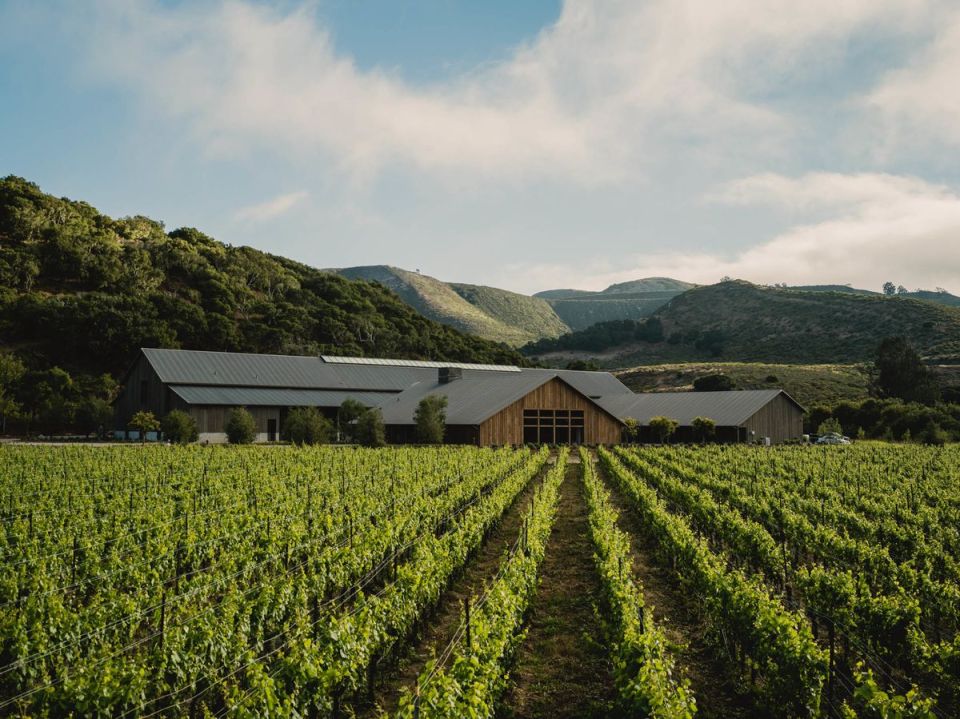
The easiest one-two punch starts at Santa Ynez’s Crown Point, esteemed for its warm cabernet sauvignon, and wraps up at the award-winning Bordeaux-centric Happy Canyon Vineyard next door. Not far away, on the north side of town, is The Hilt, whose new tasting room, designed by Howard Backen, serves excellent chardonnays and pinot noirs with what may be the most idyllic view of all.
Where to Stay

The aforementioned Winston may be the latest and most luxurious of Highway West’s hotels in the area, but it has good company in its sibling, the Vinland, which is appropriately Scandinavian given its central Solvang setting. Ditto the Landsby, an independently owned boutique hotel, also in the Dutch town, whose style is all clean lines and soothing monochrome.
Also new and noteworthy is Hotel Ynez, which opened in March with 18 cozy rooms—they have fireplaces, mini Smeg fridges, and Mascioni linens—midway between Solvang and Santa Ynez. Its highlight is a central courtyard with hammocks and roaring firepits.
“Things haven’t even peaked yet,” says Kimberly Walker, who owns both Hotel Ynez and the nearby Skyview motel in Los Alamos. “There’s a genuine sense of hospitality, and people who would normally visit Sonoma or Napa are realizing that and coming here instead.”
Source: California’s Best-Kept Wine Secret Is Just a Short Drive From L.A.
‘Drink Less, But Better’: Actor Sam Neill on Winemaking and What’s Next

In this interview, Sam Neill discusses everything from shooting a film during the pandemic to his thoughts on natural wine.

Though movie fans may know him for blockbusters like Jurassic Park or indie flicks like Hunt for the Wilderpeople, Sam Neill’s reputation in the wine world hangs on Pinot Noir.
In 1993, he established Two Paddocks winery in Central Otago, New Zealand. Since then, the estate has earned accolades for vibrant, transparent Pinots produced from four distinct vineyards.
We last chatted with Neill back in 2008. With Jurassic World: Dominion now on the horizon, we decided to check in again—this time, via Zoom from his quarantine hotel room in Auckland, New Zealand—to learn more about how 2020’s events altered his perspective on wine and why natural wine can be interesting.
Have the pandemic and various quarantines changed your perspective on wine?
I’ve been encouraging people to drink less, but better. To really get interested in what’s in the glass, who grew it, what it’s about… When you’re locked down and putting up with your own company…you might as well be mindful of what you’re doing.
What was it like to film Jurassic World during a pandemic?
That was an unusual experience and one of the toughest I’ve ever had. We were locked up for effectively four to five months, tested every day for 10 days when we arrived, and three times a week after. Someone estimated they spent $5 million just on Covid-19 precautions.
“I’ve been encouraging people to drink less, but better. To really get interested in what’s in the glass.”
You’ve gushed openly about the magic of Central Otago. Do you feel the same now?
Someone once said, “You can love many places in the world, but you can only be in love with one.” The only place in the world I’m in love with is Central Otago. I get off the plane, and within an hour, I feel completely at home.
You recently produced a small amount of Pinot Noir naturally, without intervention or preservatives like sulfur. Did you find much difference between that and the Pinot you make conventionally?
We made two small batches from exactly the same plot: the Fusilier Vineyard in Bannockburn. One was a natural wine, and one was classic. It was really interesting, the results, because they were completely different wines. They could have been from a different vineyard altogether, but they were from exactly the same grapes.
Did the pandemic disrupt vineyard and cellar work for you?
When harvest hit, it was full-on pandemic, but the government made an exception for the wine industry with very strict protocols in place. Everyone got a dedicated bucket, a dedicated set of secateurs, and people had to keep about 6.5 feet apart all day. We estimate that every vine is visited by a pair of hands 14–15 times a year. It’s time consuming and repetitive work, from leaf plucking to harvest, so it helps when you’re all in it together. To be separate and doing it isn’t so much fun.
What’s your vision for the winery in the next five or 10 years?
Well, all four vineyards were certified organic in 2017. It’s becoming more important to people, and it certainly is to us. There was one vineyard that was problematic that we had to farm conventionally for a while, but we eventually decided everything had to be organic. It’s time consuming and expensive, but I couldn’t in all conscience live with myself if we weren’t farming organically and sustainably.
How do you feel about natural wine, or wine that’s made without anything added or taken away?
We got interested in natural wine, which I laugh a bit about, but there’s demand for it. We make a small amount for our wine club members… I don’t really approve of it, to be honest. How long has mankind been making wine? I suppose it’s 10,000 years or something? And one of the great breakthroughs happened about 3,000 years ago when they started putting in a little bit of sulfur from Mt. Etna in Sicily. They discovered wine could have a life, rather than be a home brew, so why we’re reverting to something your grandad made in his garage. I don’t really know.
What can you tell us about Last Chance, the beautiful windswept vineyard at the end of the world?
If I had to pick one of my vineyards, that would be the one. There are extraordinary, weathered rocks that look like ancient creatures, and green vines growing below them. It has fabulous views looking north into the sun. It seems an unlikely place for a vineyard initially, but it has the full intensity of that Central Otago sun that’s like nowhere else. It’s a bit windier than elsewhere, so it produces tough, small berries and small bunches. Alexandra, the subregion, was always overlooked, but I think we make some of the most interesting, elegant, restrained wines from there. We hold back Last Chance an extra year. It is the slowest to come forward because of these lovely tannins. Next year, we’ll release the 2018.
What’s distinct about this wine? How would you recognize it when tasting it blind?
It’s got lovely savory qualities. It’s the most savory of our wines. It’s surrounded by wild thyme. Thyme even grows between the rows. I’ve always thought that partly accounts for its profile. It also has a subtlety and a kind of reticence that calls for attention, which is exactly what I’ve been talking about, that mindfulness that you need to appreciate Pinot Noir.
Source: ‘Drink Less, But Better’: Actor Sam Neill on Winemaking and What’s Next | Wine Enthusiast
Sing For Hope Pianos Comes To Beverly Hills August 6th – Sept 6th 2021

Sing for Hope harnesses the power of the arts to create a better world. Our creative programs bring hope, healing, and connection to millions of people in hospitals, care facilities, schools, refugee camps, transit hubs, and community spaces worldwide. Founded in New York City in 2006, Sing for Hope partners with hundreds of community-based organizations, mobilizes thousands of artists in creative service, and produces artist-created Sing for Hope Pianos across the US and around the world. The official Cultural Partner of the World Summit of Nobel Peace Laureates, Sing for Hope champions art for all because we believe the arts have an unmatched capacity to uplift, unite, and heal. Learn more and join the movement at https://www.singforhope.org/.

